
Radon Testing: Get a Number You Can Act On
You cannot smell, see, or feel radon at any concentration that matters — a Will County basement at 20 pCi/L feels identical to one at 0.4. Testing is the entire diagnosis, and around Joliet it ranges from an $8 county kit to a deal-grade 48-hour licensed measurement.
Start here: which test do you actually need?
Just curious about your house? Use the cheap route first. The Will County Health Department sells $8 passive kits — lab analysis and written report included — right in Joliet. Set it in the lowest lived-in level, follow the closed-house instructions, mail it in. If it comes back under 2 pCi/L, retest in a couple of years and sleep fine. If it comes back higher, that's when to talk to us.
Buying, selling, or leasing? Now the number has legal and financial weight, and Illinois built a licensing system for exactly this. Sellers have owed radon disclosure since 2008; most landlords owe it in leases since January 2024; day cares have tested on a three-year cycle since 2013. A licensed measurement professional with a continuous monitor produces the 48-hour, tamper-evident report that inspectors, attorneys, and the other side's agent will accept without argument.
Just had a system installed? Verification isn't optional courtesy — it's how licensed mitigation closes out. The post-install test proves the system actually moved the number.
Why Will County numbers surprise people
On paper this is EPA Zone 2 — "moderate." In practice, the American Lung Association's analysis of Illinois Emergency Management Agency testing data shows over 40% of tested homes at or above the 4.0 action level, the statewide average sits at 5.1 pCi/L, and homeowner-submitted results around Joliet and Plainfield (per radonresources.com) have averaged in the 6s. The glacial soil under Will County carries the uranium traces doing the work, and it doesn't read the zone map. Neither should you — the spread between neighboring houses is enormous, which is exactly why a per-house test is the only meaningful answer.
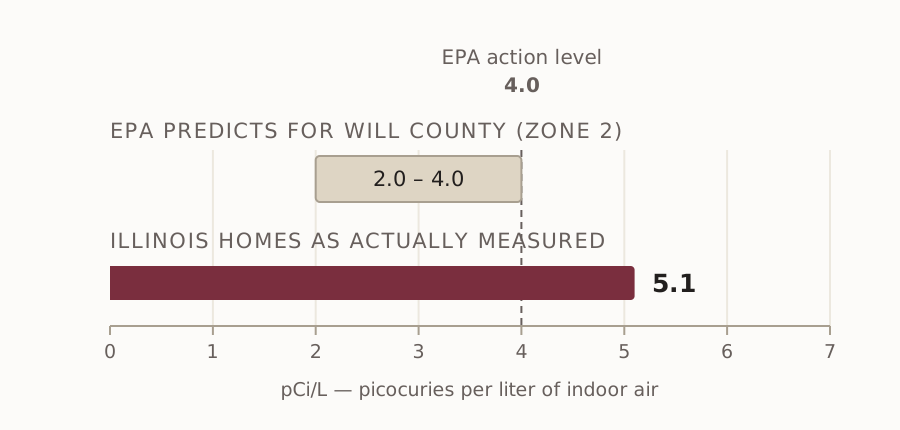
- The EPA’s 1993 zone map puts Will County in Zone 2 — a predicted county average of 2.0 to 4.0 pCi/L, the band shown on top.
- Illinois homes actually measure 5.1 pCi/L on average — above the top of that predicted band, and above the 4.0 action level itself.
Reading your result
The EPA's action level is 4.0 pCi/L: at or above it, fix the house. Between 2.0 and 4.0, the EPA says consider fixing — there's no established safe threshold, and the World Health Organization draws its reference line at roughly 2.7. Under 2.0, retest every few years and after any big change to the house (new sump, finished basement, foundation work, additions). One number nobody should ignore: a post-2013 house with a passive pipe that still tests high is one fan away from fixed.
Need a deal-grade test on a deadline?
Call (815) 348-6800Frequently asked questions
Can I really test for $8?
Yes. The Will County Health Department sells passive test kits for $8 — postage and lab report included — at its Joliet, Bolingbrook, and Monee offices. For a homeowner who just wants a first look at the number, that kit is the right move, and we'll tell you so. Where a licensed measurement earns its fee is when the result has to hold up: a real estate transaction, a lease disclosure, or verifying a mitigation system.
How does a professional test work?
The house stays closed up (normal coming and going is fine, but windows shut) for at least 12 hours before and during the test, and a licensed measurement professional places calibrated equipment — often a continuous radon monitor — for a minimum of 48 hours. You get an hour-by-hour report that shows tampering if anyone tried it, which is why deals rely on it.
When is the best time to test?
Any time is valid, but winter readings run highest: a closed, heated house pulls the most soil gas. If you test in July and land near 3 pCi/L, it's worth knowing your January number is probably higher. Radon levels also drift year to year, so retesting every couple of years — and after any mitigation — is standard advice.
I'm a landlord in Will County. Do I have obligations?
Since January 1, 2024, Illinois requires radon disclosure in most residential leases (units on the third floor or above are exempt), and tenants get a window to run their own test. If a hazard is confirmed and not mitigated by a licensed contractor, tenants may have the right to end the lease. Getting ahead of it with a documented test is cheap insurance.
Schedule a measurement
Tell us the address, the deadline if there is one, and what the test is for. We'll line up a licensed pro fast.