
Mitigation Systems: One Day of Work, Decades of Lower Numbers
A high radon reading is one of the most fixable problems a house can have. An active sub-slab system — pipe, fan, verified result — installed by an IEMA-licensed contractor typically drops levels 80–99%, and most Will County installs are done in a single day.
What actually gets installed
The principle is pressure, not filtration. Radon enters because the soil under your slab is at higher pressure than your basement, so gas flows in through every crack, joint, and pit. Mitigation reverses that: the installer cores a hole through the slab, opens a small collection pit beneath it, and runs PVC pipe from that point up past the roofline with an inline fan pulling constantly. The soil gas that used to seep into your family room now exhausts harmlessly above the eaves. Slab openings, sump lids, and major cracks get sealed so the fan's suction works on the soil instead of your conditioned air.
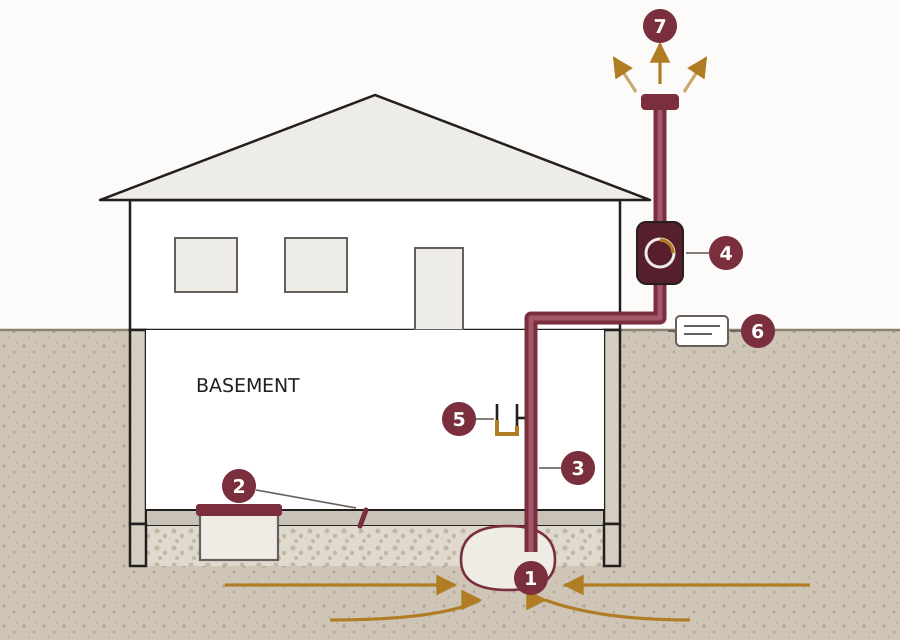
- The suction point. The installer cores through the slab and opens a small pit in the gravel below it. That pit is what the fan actually pulls on.
- Sealing. The sump lid, major slab cracks, and any open penetrations get sealed so the fan works on soil gas instead of on your heated air.
- The riser. PVC carries the gas out through the rim joist and up the outside wall. It can also run hidden through a closet chase to the roof when the exterior matters — routine on Upper Bluff and East Side homes.
- The inline fan. Roughly a light bulb’s worth of power, running continuously, about as loud as a bathroom vent. Fans typically last 10–15 years and are inexpensive to swap.
- The manometer. A small gauge on the pipe holding coloured liquid in a U-shaped tube. If the liquid sits at two different heights, the system is pulling; if it settles level, the fan has quit and it’s time to call.
- The system tag. Illinois-licensed work leaves a tag identifying the IEMA-licensed installer.
- The exhaust. Terminates above the roofline, away from windows and intakes, so the gas disperses outdoors instead of re-entering the house.
What your foundation decides
Joliet-area houses span three radon eras, and the foundation era mostly sets the price. A single poured slab from the 80s or 90s growth ring — the median Joliet home was built in 1985 — is the textbook case: one suction point, tidy exterior run. The city's older stock is craggier: limestone-foundation homes in the historic districts often pair a basement with a crawl or an addition slab, which can mean a second suction point or a membrane system in the crawl. And post-June-2013 construction already has a passive pipe by law — there, "mitigation" is often just adding the fan, the cheapest version of this job. Licensed activation is still required.
Will County pricing, plainly
Typical single-family installs around Joliet, Shorewood, Crest Hill, Lockport, and Plainfield run $1,200 to $1,700. Clean slab-on-grade or passive-pipe activations can land near $800; large footprints, multiple foundations, or interior routing through finished space can reach $2,000–$3,000. Every quote we arrange is firm before work starts — no drill-first-price-later. Our Joliet cost breakdown goes through what moves a quote inside that range.
The two proofs every legitimate install carries
Illinois licenses mitigation contractors through IEMA, and licensed work leaves a paper trail: a tag on the system with the installer's license details, and a post-mitigation test documenting the drop. When you sell the house — with radon disclosure required of Illinois sellers since 2008 — that tagged, tested system stops being a repair and starts being a selling point.
Got a number that needs to come down?
Call (815) 348-6800Frequently asked questions
Will the system be loud or ugly?
Neither, done right. The fan is about as loud as a bathroom vent and usually lives in a garage, attic, or on an exterior wall you don't look at. The pipe can run outside (painted to match) or hidden through a closet chase to the roof. On Upper Bluff and East Side homes, installers routinely route to protect the historic facade.
Does it need a permit in Joliet?
Fan-and-vent work is routine permit territory — in Joliet that's the Building & Inspectional Services Division; Shorewood, Crest Hill, Lockport, and Plainfield each have their own building departments. The licensed contractor handles the paperwork as part of the job, and it's built into the quote.
How do I know it worked?
Two proofs, both required of licensed work in Illinois: a tag on the system identifying the IEMA-licensed installer, and a post-installation test — typically 48 hours — documenting the new, lower number. If the number doesn't drop, the installer adjusts the system, not your expectations.
What about operating cost?
The fan draws roughly as much power as a light bulb and runs continuously; figure a few dollars a month. Fans typically last 10–15 years and are inexpensive to swap when they wear out. A u-tube manometer on the pipe shows at a glance that suction is alive.
Price my system
Tell us the town, the foundation type if you know it, and your test result. No pressure.